
1. Why is polypropylene (PP) material chosen for valve floats?
The selection of polypropylene (PP) is mainly based on comprehensive considerations of its dimensional stability, corrosion resistance and hygienic safety in hot water environments. In HVAC, domestic hot water and industrial heat recovery systems, the water temperature usually fluctuates between 0°C and 110°C, with frequent alternations of hot and cold. Ordinary plastics such as ABS, PVC, etc. are prone to molecular chain breakage or plasticizer precipitation under long-term hot water immersion, causing the float to expand, deform, or have surface cracks, and eventually get stuck in the valve cavity, causing the automatic air release valve to completely fail. PP material is a semi-crystalline thermoplastic, its glass transition temperature is much lower than room temperature, and it can still maintain good rigidity and creep resistance at high temperatures. The long-term use temperature can reach 110°C, and it can withstand 130°C in the short term without permanent deformation.
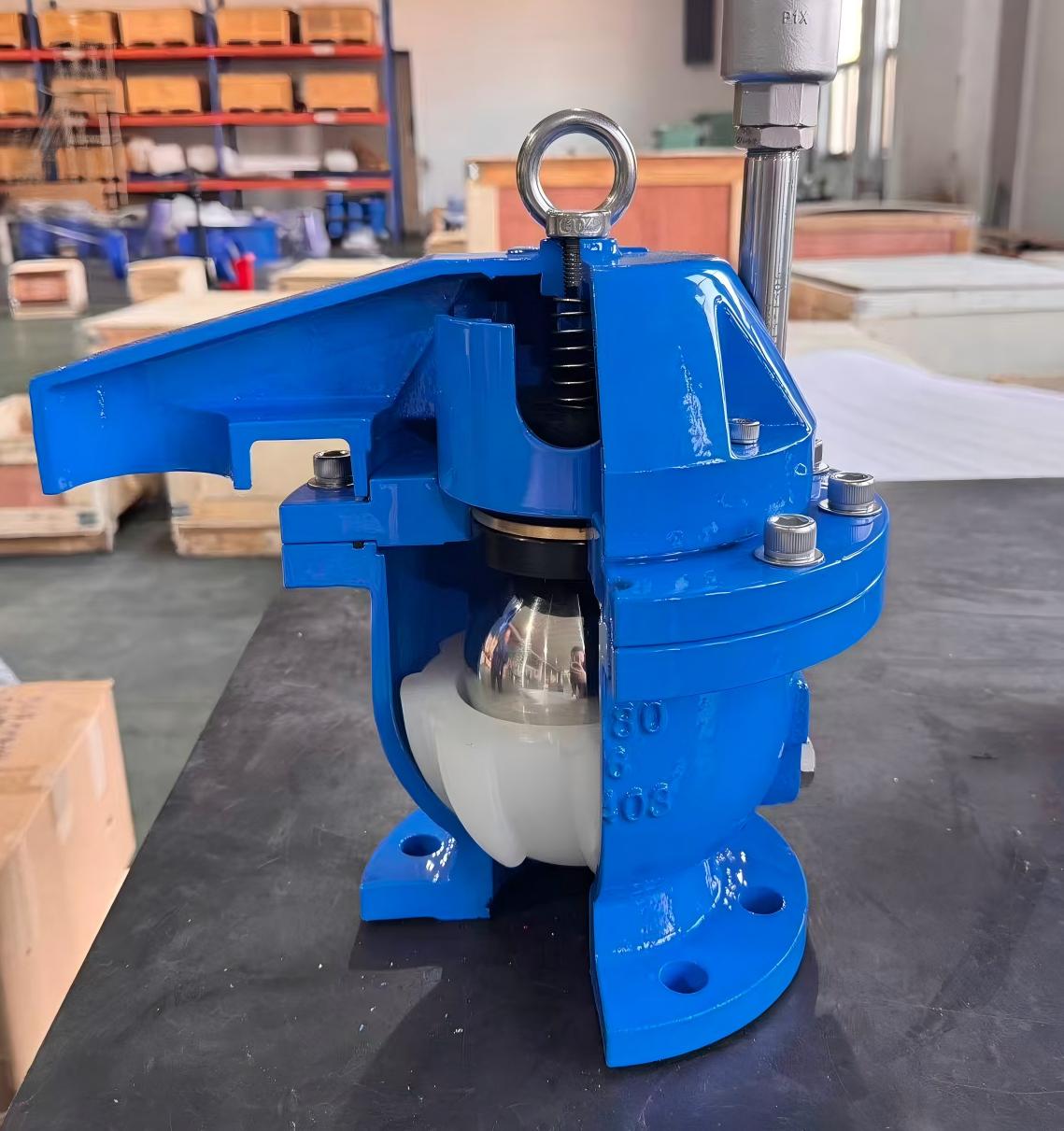
Furthermore, PP has a density of approximately 0.90–0.92 g/cm³, significantly lower than that of water. This ensures ample buoyancy, allowing the float to rise and seal properly even if its surface develops slight scaling. In terms of corrosion resistance, PP exhibits excellent resistance to acids, alkalis, salts, and most organic solvents. Notably, it is insensitive to chemical constituents such as residual chlorine in tap water and scale inhibitors/corrosion inhibitors in industrial circulating water, avoiding the electrochemical or pitting corrosion experienced by metal floats (e.g., copper or stainless steel). Additionally, PP meets food-contact-grade standards; when used in potable water systems, it poses no risk of heavy-metal leaching and offers superior hygienic safety compared to brass.
2. Compared to metal floats, what are the obvious advantages of PP floats?
PP floats offer significant advantages in corrosion resistance, lightweight design, cost-effectiveness, and ease of maintenance, making them suitable for the vast majority of water quality conditions.
First, there is no risk of rust and scaling. When metal buoys (such as brass, stainless steel 304/316) are exposed to water containing dissolved oxygen, chloride ions or hydrogen sulfide, the surface is prone to oxide layer, pitting corrosion or microbial slime adhesion after long-term operation. Especially after the lever movable joints are rusted, the friction increases, causing the buoy to lag or even get stuck. However, PP material has no electrochemical corrosion problem at all. It has low surface energy and is not easy to adhere to scale and biofilm. Even in northern areas where water quality is relatively hard, scaling is loose and can be restored through simple cleaning.
Second, it is light in weight and responsive in action. The density of PP is only about 1/8 that of stainless steel, and the weight of the float is lighter for the same volume, which means that the float responds more quickly to changes in liquid level – the immersion height required for floating is lower, and the opening and closing liquid level difference of the automatic air release valve can be controlled within ±2mm. However, due to the heavy weight of the metal float, it often requires a higher liquid level change to drive the lever, and the action lags significantly.
Third, the manufacturing cost is low. PP floats use injection molding technology, which can produce multiple cavities at one time, with high material utilization. The cost of a single piece is only 30% to 50% of that of stainless steel floats of the same specifications. The processing accuracy is easy to ensure and the batch consistency is excellent.
Fourth, maintenance and replacement are convenient. PP floats are light in weight and require no special tools when dismantling them, and can be operated by one person. Metal floats, on the other hand, are heavy and prone to rust, and may encounter thread seizure or jamming problems during disassembly. However, it should be noted that the impact resistance and wear resistance of PP floats are not as good as those of metal. If the medium contains a large amount of sand or hard particles, stainless steel is preferred.
3. What malfunctions may occur during the operation of PP pontoon valves, and how can they be diagnosed?
There are three types of common faults – continuous leakage, no exhaust and non-stop exhaust, which are mostly caused by impurity blockage, scaling or aging of seals. They can be systematically checked according to the following steps.
Category 1: Continuous leakage (valve cannot be closed). Possible reasons:
①The sealing gasket (made of EPDM or NBR) is worn or aged and deformed;
② Thick scale is attached to the surface of the float, and the buoyancy is insufficient to seal tightly;
③The hinge of the lever is stuck by sand, and the float cannot float into place.
Troubleshooting method: Close the isolation valve, disassemble the valve cover and take out the float assembly, check whether there are scratches, cracks or flattening of the indentation on the surface of the sealing gasket, replace it if any; check whether there is hard scale on the outer wall of the float and the inner wall of the valve cavity, clean it with a soft brush and clean water. It is strictly forbidden to use a metal scraper to avoid damaging the surface.
Category 2: No exhaust (air cannot be exhausted). Possible reasons:
①The exhaust hole is completely blocked by impurities;
② The pontoon broke due to accidental water intrusion, lost buoyancy and sank but blocked the exhaust port.
Troubleshooting method: After closing the isolation valve, manually push up the lever and observe whether the exhaust hole is unobstructed; put the removed pontoon into clean water, press it and release it, and observe whether there are bubbles emerging. If there are, it means that the pontoon is broken and water has entered, and needs to be replaced as a whole.
Category 3: Incessant exhaust (the valve port opens and closes frequently or there is continuous exhaust). Possible reasons:
① There is a continuous air intake source in the system itself (such as water pump shaft seal leakage, water replenishment system bringing in a large amount of dissolved oxygen);
②The buoyancy of the buoy decreases and the critical opening and closing points shift.
Troubleshooting method: First confirm whether there are leaks in other parts of the system. If not, check whether the density of the float has increased due to long-term high-temperature aging (the PP material may absorb a small amount of water and gain weight after being soaked in high-temperature water for a long time). If the buoyancy drops significantly, replace the float with a new one.
4. Conclusion
TWS’s automatic air release feature PP floats that meet food-grade and hygienic standards. With low density and ample buoyancy, they provide precise liquid-level control within ±2 mm for more responsive venting. Resistant to prolonged exposure to 110°C hot water and fully tolerant of acids, alkalis, salts, and residual chlorine, they eliminate corrosion-induced seizing common with metal floats. Injection-molded at only 30–50% of the cost of stainless steel, they can be easily removed and maintained by a single person. The first choice for HVAC, domestic hot water, and industrial heat recovery systems—TWS Valve and Solution For Water
Post time: Nov-11-2026


