
In pipeline connections, double-flange limit expansion joints (VSSJA-2/B2F type) and double-flange power transmission joints (VSSJAF/C2F type) are two common products with different functions. Although both are used to connect pipes with flanges at both ends, they are obviously different in appearance design and core function.
I. Differences in structure and appearance
1. Double Flange Restrained Expansion Joint (VSSJA-2/B2F)
- Core components: composed of body, sealing ring, gland and telescopic shortening.
- Appearance features: There are 4 flanges on the body. The length of the limit bolt does not exceed the product itself, and the overall structure is relatively compact.
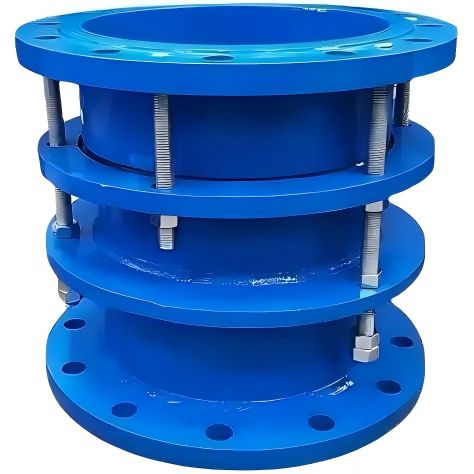
2. Double Flange Force Transfer Joint
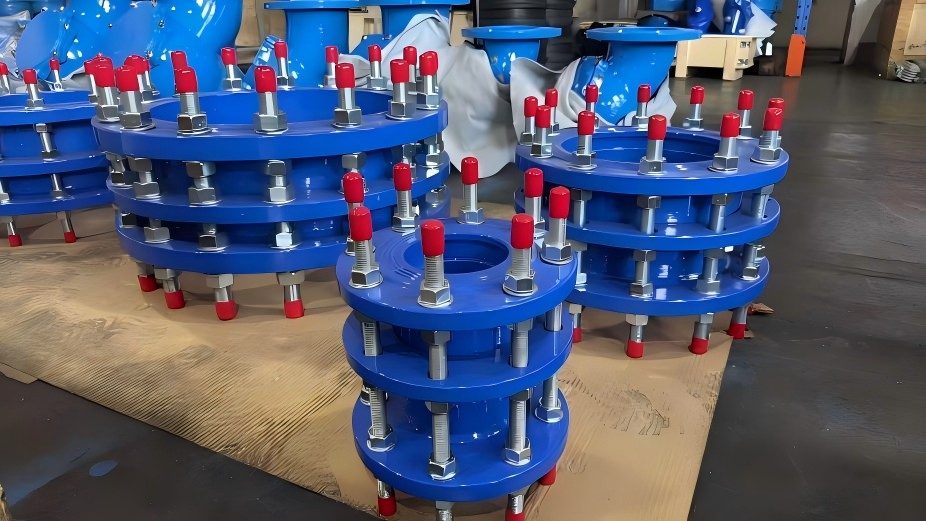
- Core components: composed of body, sealing ring, gland, short tube flange, long studs and nuts.
- Appearance features: There are 3 flanges on the body. Its connecting force transmission stud is obviously longer than the product body, which is the most intuitive identification point.
II. Core functions and working principles
1. Double flange restrained expansion joint: compensation and protection
Its core function is to compensate for thermal expansion and contraction of pipelines, absorb axial and radial displacement, and ensure the safe operation of the pipeline system through limit devices.
- Allow expansion and contraction: Within the normal range, it can expand and contract freely to compensate for the displacement of the pipe caused by thermal expansion and contraction.
- Safety limit: When the expansion and contraction reaches the limit, the limit bolt will act as a mechanical barrier to prevent the pipeline from being disjointed or damaged due to excessive displacement.
- Applicable scenarios: It is especially suitable for pipelines with vibration, a certain slope or a bend. It can effectively cope with axial displacement within a certain angle, and also facilitates the installation and maintenance of valves and water pumps.
2. Double flange force transfer joint: Transfer thrust and connection
Its core function is to transmit the axial thrust of the pipeline, compensate for installation errors, and ensure the stable operation of pumps, valves and pipeline systems.
- Lock length: During installation, it is necessary to adjust to the required length according to the actual reserved distance, and lock the force transmission bolts so that the product maintains a fixed length during operation.
- Main functions: During operation, it does not mainly rely on expansion and contraction to compensate for displacement (only a certain trace amount of displacement), but serves as a rigid connector to efficiently transmit the axial force generated by the equipment to the pipeline system to avoid concentrated thrust damage to the equipment.
- Applicable scenarios: Often used to connect pumps, valves and other equipment to pipelines to ensure even distribution of thrust.
III. Conclusion
If the pipeline is subject to temperature difference expansion and contraction, foundation settlement, and elbow vibration, and it is necessary to compensate for displacement and prevent pull-off, double flange limit expansion joints are selected;
If connecting water pumps and valves, it is necessary to disperse the axial thrust and protect the main body of the equipment, so the double flange power transmission joint is preferred.
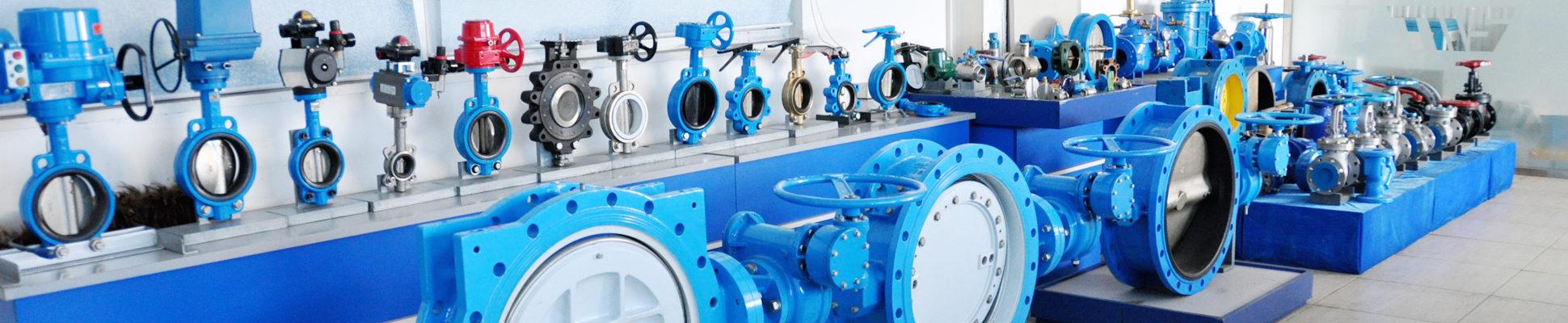
In the pipeline system, double-flange limit expansion joints and double-flange power transmission joints are key accessories responsible for the “connection and protection” of pipelines, while butterfly valves, gate valves, and check valves are the core equipment for controlling the “flow and cutoff” of the medium.
Post time: Aug-13-2026


